Saturday, 12 January 2013

The Maldives

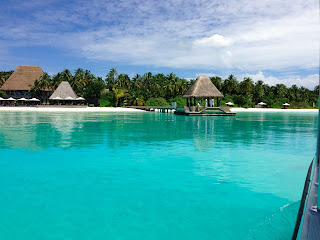
In October we went to the Maldives for the kids’ Diwali Break. It was, by far, the most beautiful exotic location we have ever visited. The deep turquoise blue waters, endless blue skies, soft white sand and lush vegetation was a real treat to the senses.


The Maldives is a long and narrow country formed by 26 natural atolls that sits in the Indian Ocean, 250 miles southwest of India. The Maldivian atolls (ring-shaped coral islands) are spread out over 35,000 square miles, making the country one of the world’s most geographically dispersed and least populated. Its population of 330,000 people inhabits only 192 of its 1192 islands. The country’s many resorts each occupy its own island.

We stayed on the island of Kihavah, which we reached by a 35 minute ride on a sea plane from Male International Airport. During the ride we were glued to our windows as we glided over the breathtaking waters and tiny Maldivian islands in the middle of the Indian Ocean.


We touched down beside the welcome jetty. 


Then we took a boat to the resort, where Sanjay welcomed us as he arrived a few hours earlier from the U.S. 

As we docked we were taken away by the beauty of the island! 


Since our resort (the Anantara) encompassed the whole island, the children thought of it as their own playground. They  felt so independent as they wandered from the Recreation center to the pool to the beach and back to our villa. Their days were full of table tennis, swimming, tennis, catching the waves and lying in the sand. 


There were a lot of great photo opportunities! 


The snorkeling in the Maldives is undoubtedly one of the best snorkeling experiences in the world. The atoll topography and house-reef conditions is right for ideal snorkeling. (A house reef is an ephemeral island built by a submarine volcano whose top has repeatedly breached the surface and was subsequently eroded by wave action). The big event in snorkeling is the house reef drop off -- where the depth goes from a few meters to virtual oblivion. As you swim along the precipice, it is the closest feeling to flying as you look out in the open water, which looks like a massive canvas of aquatic color.  Closer to the coral reef you experience a stunning underwater garden teaming with endless colorful and diverse fish, turtles and perhaps even a small shark. 

Here are some pictures taken from our boat...


Back at our resort we went out for scrumptious dinners every evening. 


This was the resort's dining complex where we feasted on Asian cuisine and unbelievably fresh seafood. 


One afternoon we dined at the resort's underwater cellar and restaurant. We were surrounded by colorful schools of fish as we dined on the catch of the day. 


Another afternoon the kids experienced their first dive. Priya was like a fish in water but Akash had problems equalizing. 


Our week in the Maldives was pure relaxation. A morning dip in our villa's pool was followed by a leisurely breakfast and long walks amongst the island's vegetation.


Before we left our family was invited to plant a coconut tree. 


We were so sad to leave this idyllic island paradise...


...but we know we will return as we're not sure how long this pristine set of islands will be around. Climate change and rising sea levels are of great concern to the Maldives, which is only 5 feet above sea level. As global warming causes the polar ice caps to melt, sea levels are expected to rise 1 inch/year. This puts the Maldives entire existence in jeopardy in a mere 60 years!! Needless to say, we hope these predictions are wrong. 

Sunday, 2 December 2012

Girl's Trip to Mumbai


In October, Priya and I took a girl's trip to Mumbai for a week. Priya was invited to compete at Squash Nationals where the top 32 U11 girls from all over India competed at the Cricket Club of India in Mumbai. We stayed at the Oberoi on Nariman Point, a hotel that overlooked the Arabian Sea and offered breathtaking views. 


Priya' tournament lasted 5 days and our hotel was conveniently located 5 blocks away from the venue. Every morning, at the crack of dawn, we walked along the serene beach to Priya’s match. It was such a peaceful time to experience the usually bustling city and it gave Priya a chance to clear her thoughts and think about her strategy for the match she was about to play.


Since Priya has never competed on the Indian squash circuit before she had to play a few qualifying rounds to get in the main draw, which she played with ease. Once she entered the main draw, the matches got a lot more exciting and were full of emotion on my end  as I cheered Priya on and felt every point as if it were my own. Priya played very competitively and in the course of the week she took her game to a completely new level. She faced some tough competition but she handled it with great form and grace. She ended up placing 7th in India for girls U11. We were so proud of her!!


During the week, Priya met some amazing athletes from Chennai, Mumbai, Delhi and many other Indian cities. Many of her opponents watched her matches out of curiosity to figure out where this new competitor with an American accent came from. It was fun for me to meet the other parents and tell them our story. They all agreed that Priya is a real up-and-comer on the Indian squash circuit. 

After the tournament ended we spent a couple days exploring Mumbai. Mumbai was known as 'Bombay' until 1996, a name that emerged from the Portugal term "Bom Bahai" meaning good bay or harbor. What I find most interesting about Mumbai's geography is that it was originally 7 different islands that were joined by land reclamation.  

Since Priya has been studying Mahatma Gandhi at school, our first stop was Mani Bhavan, the home Gandhi stayed at on and off from 1917 to 1934 and from where he initiated his political activities. It has since become a memorial to Gandhi.


Gandhi’s association with the Chakra (a small, portable, hand-cranked wheel for spinning cotton and other fine fibers) began while he was staying at Mani Bhavan. Gandhi brought the chakra into larger use with his teachings, which stressed that Indians should not be sending their cotton bales to England to get woven, spun into cloth, sewn and then sold back to India at prices they could not afford. In order to resist against the British, Gandhi encouraged Indian men to spin (which was traditionally women’s work), weave their own cloth and wear clothing made from this homespun cloth. As part of the passive resistance movement, Gandhi would often spin in public. The chakra now symbolizes Indian quest for independence and is proudly displayed on the Indian flag.

The main floor of Mani Bhavan houses a beautiful library where many of the actual books Gandhi read are preserved in a bookcase. Here Priya is sitting in front of that bookcase. 


The 2nd floor houses a big photo gallery where photographs, letters and press clipping from Gandhi’s childhood till his assassination are displayed. One of the letters was one written to Hitler in 1939 urging him not to war and instead try passive resistance, an approach Gandhi followed.


The room that Gandhi used during his stay at Mani Bhawan was on the 3rd floor. This was Priya’s favorite part of the memorial. Through the glass partition we saw Gandhi’s spinning wheels, a floor bed and many of his personal belongings still preserved.


After leaving Mani Bhawan we went to the lush green Hanging Gardens, on the slopes of Malabar Hill in South Mumbai. The gardens greeted us with a hedged archway that led us to the beautifully manicured lawns.


Priya loved the animals sculpted out of hedges. Her favorites were the giraffe and the man seated on the elephant.


From the park we saw a view of Antilia, the 27-floor personal home belonging to businessman Mukesh Ambani, chairman of Reliance Industries. The home, which is valued at $1 billion, is considered the most expensive in the world. Antilia has its share of controversy; while some Indians are proud of the ostentatious home, others see it as shameful in a nation where many children go hungry. 


Right outside the Hanging Gardens we got a stunning view of Chowpatty beach and Marine Drive, a popular spot for watching sunsets and especially gorgeous when lit up at night.


This is Mumbai’s historic railway station (called Chhatrapati Shivaji Terminus). The station building was designed in the High Victorian Gothic style of architecture by an English architect is the late 1800s who was commissioned to construct the station after a masterpiece watercolor sketch. The final design bears some resemblance to the St. Pancras railway station in London. It is a UNESCO World Heritage Site. 


Finally we made it to the Gateway of India in Colaba, a monument built during the British Raj to commemorate the landing of their Majesties King George V and Queen Mary, when they visited India in 1911. The gateway overlooks the Arabian Sea and in earlier times was the first structure that visitors arriving by boat in Mumbai would see.


Across the street is the famed Taj Mahal Hotel, which was built in 1903 (during British rule) by Jamsetji Tata, an Indian industrialist. The story goes that he built the hotel after he was refused entry to one of the city’s grand hotels of the time because he wasn’t white. The hotel is considered one of the finest in India and has hosted many U.S. presidents, dignitaries, royalty and Hollywood A-listers (i.e. Bradgelina). The hotel was rebuilt after the 2008 terrorist attack. Priya and I had dinner there one evening and we could really feel the British history and glamour that is interwoven into the hotel's fabric. 


Around the corner from the hotel we visited the newly opened Starbucks, the first in all of India. We had to give it a try so we stood in the line that extended outside the front door to try the chai latte.


That ended our exciting week in Mumbai. The next morning we boarded a flight back to Delhi and reunited with our boys. 


Saturday, 10 November 2012

Amritsar - Part II


From Srinagar we flew 450 km south to Amritsar, the capital of the state of Punjab. We were especially keen on coming to Amritsar to see the Golden Temple, one of the most holy places of the Sikh religion.

Once we arrived in Amritsar, we could immediately feel the hustle bustle of the city, which was quite the contrast to the calm and slower paced feel of Srinagar.  Punjab, like Kashmir, is one of the few states in India that is home to primarily one religion other than Hinduism. Walking in the crowded streets of Amritsar I was taken away by all the color in the air -- not only from women adorned in beautiful salwar kameez and saris but also by Sikh men who adorned brightly colored turbans.

Geographically, Amritsar lies very close to the northwest border of India with Pakistan. In fact, we were only 30 miles away from where Osama Bin Laden was killed in Pakistan.  The closest border crossing to Pakistan is the Wagh Border, which until recently was the only road connecting India and Pakistan. Every evening before sunset the border hosts the Wagah Border Ceremony – a daily military practice that the security forces of India and Pakistan have jointly followed since 1959.

We were very curious to see this much-celebrated ceremony so we drove there our first afternoon. The last mile to the border we walked in the blistering heat amongst crowds of Indian nationals. Once we arrived we noticed that the Indian nationals had to wait in long lines to gain admittance to the ceremony. Meanwhile, International tourists went through a fast lane and were priority seated in a VIP section. We literally waltzed in with our U.S. passports and got great seats amongst rows of International tourists.


In this picture you can see the closed gate on the border of India and Pakistan where much of the ceremony takes place. In the distance is the Welcoming Gate to Pakistan. On our side of the border is India’s welcoming gate with a prominent picture of Mahatma Gandhi.

We arrived about 30 minutes before the ceremony began but for us the entertainment had already begun. Popular Indian music blared over the loudspeakers as the Indian nationals sung and danced in circles to show their immense pride in India. School kids of all ages joined in the fun. There was so much patriotism buzzing in the air that it was infectious! It felt like Indian Independence Day!!


Then the ceremony began. The ceremony started with a blustering parade by the soldiers from both sides, and ended up in the perfectly coordinated lowering of the two nation’s flags. A soldier stood at attention on each side of the gate and, as the sun set, the iron gates at the border were temporarily opened while the two flags were lowered simultaneously.


The flags were then folded and the ceremony ended with a retreat and the soldiers shook hands before the gate closed again.


It was a really beautiful ceremony with lots of pump and circumstance. As we all know, India and Pakistan have a very strained relationship, plagued by hostility and suspicion, dating back to the partition of British India in 1947. After seeing this ceremony one almost thinks that maybe relations are getting better but in reality this is a completely staged spectacle. Michael Palin of Monty Python fame said it best when he described the ceremony as a display of “carefully choreographed contempt”.

After the ceremony we traveled back to Amritsar to visit the Golden Temple, the holiest shrine of the Sikh religion. Once we get in the vicinity of the temple we parked our car and walked the last half-mile through narrow alleys bustling with vendors sitting on mattresses in their stores selling all kinds of fabric. The walk was not an easy one as we constantly dodged motor scooters and stray dogs to get to the shrine – but it was well worth it!

Once we got to the temple we had to remove our shoes, wash our feet and cover our heads.

By the time we arrived at the temple, the sun had set and the lit-up golden temple took on a regal feel as it glistened in the pool surrounding it. It was simply breathtaking! Unfortunately the crowd of people waiting to enter the temple was not deterred by the darkness or the long lines.

It normally takes two hours to navigate through the line and enter the temple but our tour guide knew the inside scoop on which line moved faster. Taking his advice we stood in line and made it in under an hour. Oddly enough, as we were standing in line, feeling very proud of our inside information, we noticed the occasional person entering through the exit line. We thought perhaps they were VIPs. We later learned that these supposed “VIPs” simply bribed the guard. Leave it to India – nothing is impossible with a bribe!

While standing in line we stared in awe at the temple’s beauty. The Golden Temple sits on a rectangular platform, surrounded by a pool of water called the Amrit Sarovar from which the City is named. The temple is simply breathtaking with its rich ornamentation full of marble sculptures, golden gilding and precious stones! It’s no surprise that the shrine attracts more visitors than even the Taj Mahal!


Upon doing some research I realized that the location of the temple has much historical significance. Originally the site of the temple was a small lake in the midst of a quiet forest where wandering sages came to meditate. Even the Buddha spent time here meditating. Two thousand years later, Guru Nanak, the founder of the Sikh religion, came to live and meditate by the peaceful lake. After he passed away his disciples continued to frequent the site – and over the next 70 years, in the early 1600s, the lake was enlarged and the Golden Temple was built.

On numerous occasions the Muslims destroyed the temple – a recurring theme in Indian history – but each time the temple was built even more beautifully. The architecture of the final rendering draws on both Hindu and Muslim artistic styles.

This is an aerial view of the temple during the day. 


Once we entered the temple we walked through an ornate archway with intricate inlay work. After going up and then down a flight of stairs we passed through the Darshani Deori to enter an ornate chamber where musicians sang and played beautifully melodic music on the harmonium, sitar and tabla in front of their Guru. Onlookers were chanting and praying and seemed to be in a spiritual state. It felt so calm and peaceful to be in their presence. It was a beautiful experience!


The next day we visited the Jallianwala Bagh Memorial, the site of the April 13, 1919 massacre of hundreds of innocent Indians by British troops – a major event in India’s struggle for freedom.

Spread over 6.5 acres of land, Jallanwala Bagh was a popular ground for holding meetings and protest during the Freedom Struggle in India. On the day of the massacre a large crowd of around 20,000 people had assembled at Jallianwala Bagh to protest against the arrest of two Indian freedom leaders. As they were listening to the speeches of their leaders, a British General ordered his soldiers to block the only exit gate and to fire 1,600 rounds of bullets on the unarmed and helpless crowd.

This memorial was extremely moving and seemed especially familiar as it is represented in the movie “Gandhi”. Akash watched the movie in school last year with his History class and vividly remembered the massacre and its impact on India.

The Indians trapped in Jallanwala Bagh that day were so desperate to escape the bullets that they jumped into this well and then drowned.

The memorial also preserved the remnants of this wall, which has actual bullet marks from the massacre.

At another side of the garden is an eternal flame of remembrance, named the ‘Flame of Liberty’, set up in commemoration of those who died at the Jallianwala Bagh massacre. The main memorial is in the shape of a bullet so that Indians never forget the violence that erupted on this sad day in Indian history.


This ended our sightseeing in Amritsar. A couple hours later we boarded a flight back to Delhi. While waiting to go through security we noticed a Sikh man dressed in religious clothing carrying a strapped curved sword. Very religious Sikh men wear this sword as one of the five items of faith to the Sikh religion. In this day and age, we never thought he would get through security but, sure enough, he breezed right through. Priya was especially shocked and exclaimed, only in Amritsar!

When we arrived back in Delhi the kids were thoroughly exhausted from our busy travels but came back with great memories of our trip. We saw so much that weekend; it’s not often that you get to visit meccas of two major religions in one weekend!